Description
1800°C MoSi2 heating elements specially designed for dental zirconia sintering furnaces. Precise temperature control, fast heating, high purity molybdenum disilicide. OEM & replacement.
Keywords
dental zirconia sintering furnace MoSi2, zirconia furnace heating element, 1800C zirconia sintering heater, dental zirconia MoSi2 rod, sintering furnace molybdenum disilicide
Description
1800°C MoSi2 heating elements specially designed for dental zirconia sintering furnaces. Precise temperature control, fast heating, high purity molybdenum disilicide. OEM & replacement.
Keywords
dental zirconia sintering furnace MoSi2, zirconia furnace heating element, 1800C zirconia sintering heater, dental zirconia MoSi2 rod, sintering furnace molybdenum disilicide
Why Your Dental Zirconia Sintering Furnace Lives or Dies by Its Heating Element
If you have ever pulled a zirconia bridge out of the sintering furnace only to find it cracked, discolored, or with the wrong shrinkage factor, you know how frustrating that moment is. More often than not, the culprit is not the zirconia block or the sintering program — it is the heating element inside the furnace slowly drifting out of spec.
In dental labs across the world, zirconia restorations have become the standard for crowns, bridges, and implant frameworks. The material is strong, aesthetic, and biocompatible. But none of that matters if the sintering step goes wrong. And the single most critical component in that step is the MoSi2 heater.
This article walks through what you need to know about 1800°C MoSi2 Heating Elements for Dental Zirconia Sintering Furnaces — how they work, why they fail, and how to pick the right one for your furnace.
What Actually Happens During Dental Zirconia Sintering
Before we get into the heating element itself, it helps to understand what is happening inside the furnace.
A pre-sintered zirconia block (the “green” state) is roughly 50% dense. When you mill a crown from it, it is oversized on purpose. During Dental Zirconia Sintering, the furnace ramps up to temperatures between 1450°C and 1600°C — depending on whether you are working with 3Y-TZP, 4Y-PSZ, or the newer 5Y-PSZ high-translucency materials. At those temperatures, the zirconia particles densify through solid-state diffusion, and the restoration shrinks by about 20–25%.
The sintering program is carefully staged: a slow ramp to burn out binder residues, a hold at intermediate temperature, then a controlled climb to the peak sintering temperature, followed by a dwell and a slow cool. Every stage matters.
Here is the thing most lab technicians learn the hard way: if the MoSi2 heating element is not delivering uniform, stable heat across the chamber, different parts of the same restoration see different thermal histories. The result? Uneven shrinkage, marginal gaps, color variation, or — in the worst case — a cracked bridge that goes straight into the scrap bin.
This is why a quality MoSi2 heating element is not just a consumable. It is the difference between a consistent sintering result and a furnace you cannot trust.
Why MoSi2, and Why U Type?
Molybdenum disilicide (MoSi2) has been the go-to heating element material for high-temperature furnaces for decades, and for good reason.
At operating temperature, a protective SiO₂ glass layer forms on the element surface. This layer self-heals — if it gets scratched or damaged during handling, it reforms once the element is heated again. That means a MoSi2 heater can survive in oxidizing atmospheres at temperatures that would destroy Nichrome or Kanthal elements in hours.
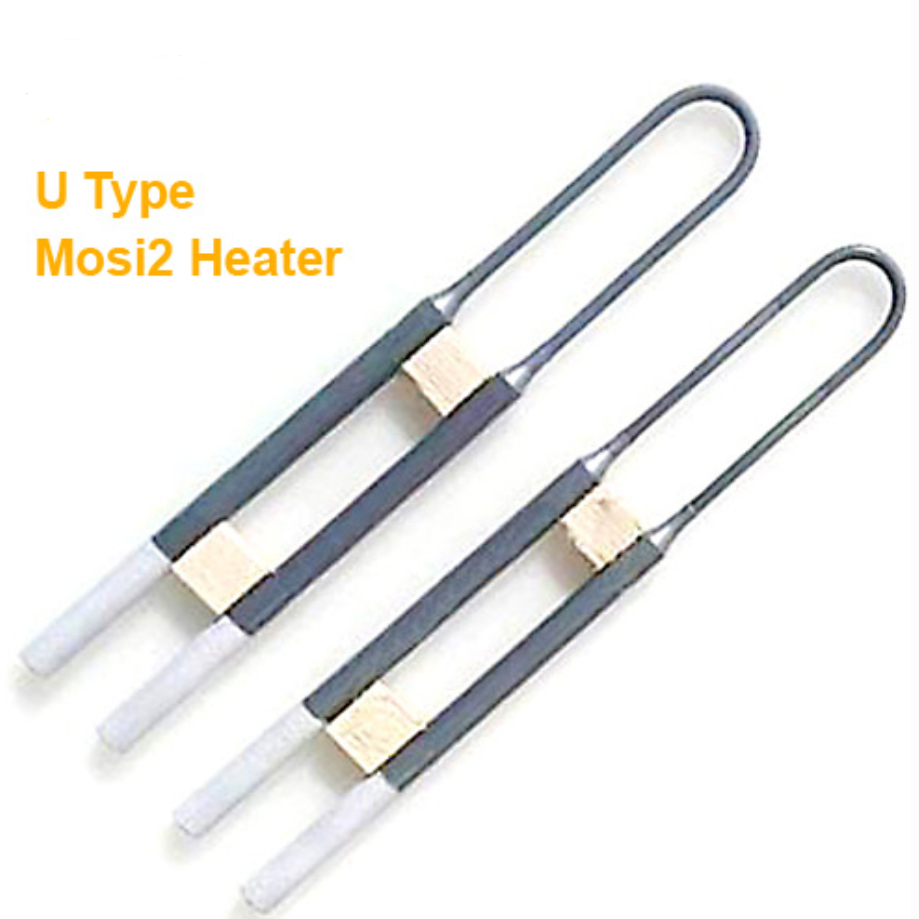
The U type configuration is the standard for Dental Zirconia Sintering furnaces for practical reasons. Two vertical cold ends connect to a horizontal heating section at the bottom, forming a U. This shape:
• Fits neatly into the furnace chamber’s side or floor channels
• Distributes heat evenly across the sintering tray
• Makes replacement straightforward — lift out the old U, drop in the new one
• Allows the cold ends to stay well below the element’s maximum rating, extending terminal life
For dental furnaces specifically, the U type 1800°C MoSi2 heating element is the dominant configuration. Most bench-top sintering furnaces — whether from major European brands or Chinese OEMs — use one or two U-type elements arranged around the chamber. If you are sourcing a MoSi2 Heater for the first time, the U type is almost certainly the form factor your furnace was designed for.
The 1800°C Rating: What It Means in Practice
You will see these elements advertised as “1800°C MoSi2 heating elements.” That is the element’s maximum surface temperature rating, not the furnace’s operating temperature. In practice, a Dental Zirconia Sintering furnace runs at 1450–1600°C at the workpiece. The element surface runs hotter — typically 100–200°C above the chamber temperature — because heat has to transfer from the element to the insulation to the load.
So an 1800°C-rated element gives you a comfortable safety margin for zirconia sintering. It means the element is not being pushed to its absolute limit during every cycle, which directly translates to longer service life.
This is a key point when comparing suppliers. An element rated to 1700°C might cost less, but if your furnace regularly hits 1550°C chamber temperature, the element surface is already at 1700°C+ — and you will be replacing it twice as often.
Real-World Failure Modes in Dental Sintering Furnaces
After years of supplying replacement elements to dental labs and furnace repair companies, we see the same failure patterns over and over:
1. Resistance drift. As the element ages, its resistance slowly increases. The furnace controller compensates by driving more voltage, but eventually the element cannot reach the set temperature. You will notice sintering times getting longer, or the furnace throwing “temperature not reached” errors. This is the most common reason labs replace their MoSi2 heating element.
2. Hot spots and element sag. Over many cycles, the heating section can develop localized hot spots where the material has thinned. In severe cases, the U-bend sags and touches the furnace insulation, causing arcing or a short. If you open your furnace and see the element glowing unevenly — bright orange in one spot, dull red elsewhere — it is time for a replacement.
3. Terminal corrosion. The cold ends where the element connects to the power supply can oxidize over time, especially if the furnace seal is leaking and moist air gets in during cooldown. High resistance at the terminal generates extra heat, accelerating the problem.
4. Mechanical damage during cleaning. It is surprisingly easy to nick or crack a MoSi2 element while brushing out sintering residue from the chamber. A small crack might not fail immediately, but it creates a stress concentration that will propagate over the next few dozen cycles.
The good news: all of these are predictable. A well-made U type MoSi2 Heater in a properly maintained Dental Zirconia Sintering furnace should last 2–4 years under normal lab use (roughly 2,000–4,000 cycles).
How to Spec the Right Replacement Element
When it is time to replace the heating element in your Dental Zirconia Sintering furnace, getting the dimensions and electrical specs right is critical. A wrong element will not just underperform — it can damage your furnace controller.
Here is what we ask every customer to provide before we quote a replacement:
| Parameter | Why It Matters |
| Cold end diameter & length | Must fit the existing terminal holes and connection clamps |
| Heating section diameter | Determines power density and surface load |
| Heating zone length | Must match the chamber width for even heat distribution |
| U-bend radius / center distance | Must align with the furnace’s element channel layout |
| Resistance value (Ω) at room temp | Must match the controller’s output range |
| Voltage & power rating | Mismatched voltage = underheating or controller damage |
| Overall length | Must clear the furnace lid and base insulation |
If you have the original element in hand, measure it carefully and take photos from multiple angles. If you only have the furnace model number, send that too — most major brands have known element specifications we can cross-reference.
One common mistake: ordering an element based only on “it looks like a U type for a dental furnace.” Two furnaces from different manufacturers might both use U-type elements, but the dimensions, resistance, and power ratings can be completely different. Always confirm the specs.
Custom vs. Standard: When You Need What
For the most common dental furnace models, standard replacement MoSi2 heating elements are available and usually ship quickly. But there are situations where a custom MoSi2 heating element is the right call:
• Obsolete furnace models where the original manufacturer no longer supports parts
• Custom-built or modified furnaces used in research or high-volume production
• Performance upgrades — for example, switching to a higher-density element for faster cycle times
• Multi-element arrays in larger production sintering furnaces
A reputable manufacturer can produce custom elements from drawings, samples, or even detailed photos with measurements. Lead time is typically 5–15 working days depending on complexity and quantity.
Typical Dental Zirconia Sintering Scenarios and Element Demands
Different dental labs run different sintering profiles, and each one puts different demands on the MoSi2 Heater. Here are the most common scenarios we encounter:
Scenario A — Single-unit crowns and small bridges (3Y-TZP). This is the bread-and-butter application. Peak temperature around 1450–1500°C, dwell time 1–2 hours. The furnace cycles once or twice a day. A standard U type MoSi2 heating element handles this easily and will typically last 3–4 years.
Scenario B — High-translucency zirconia (4Y/5Y-PSZ). These materials require higher sintering temperatures — often 1550–1600°C — and longer dwells to achieve full translucency. The element runs hotter and for longer periods, accelerating aging. In this scenario, we recommend the 1800°C MoSi2 Heating Elements for Dental Zirconia Sintering Furnaces specifically, not a lower-rated alternative. Expect 2–3 years of service life.
Scenario C — High-volume production labs. Labs running 3–5 cycles per day, seven days a week, put enormous thermal cycling stress on the element. The repeated heating and cooling causes micro-cracking in the MoSi2 matrix over time. For these operations, we suggest keeping a spare MoSi2 Heater on the shelf and monitoring resistance quarterly. Element replacement every 12–18 months is normal here.
Scenario D — Multi-unit bridges and full-arch frameworks. Larger restorations require slower ramps and longer holds to prevent thermal shock cracking. The total cycle time can exceed 10 hours. While the peak temperature may not be higher, the extended time at temperature accelerates element oxidation. A high-purity MoSi2 heating element with dense microstructure is strongly recommended.
Scenario E — Speed sintering (fast-fire programs). Some newer furnaces offer “speed sintering” cycles that ramp to 1550°C in under 30 minutes. These aggressive programs put severe thermal shock stress on the element. Not all MoSi2 heaters can handle it — cheap elements may crack after just a few hundred fast cycles. If you run speed sintering regularly, specify an element rated for rapid thermal cycling.
Beyond Dental: Where Else These Elements Go
While this article focuses on Dental Zirconia Sintering, the same U type 1800°C MoSi2 heating elements show up in other high-temperature equipment:
• Laboratory muffle furnaces used for materials testing and ashing
• Ceramic sintering furnaces for technical ceramics and electronic components
• Glass melting and working furnaces in small-batch art glass and optical glass production
• Powder metallurgy sintering for MIM (metal injection molded) parts
• Heat treatment furnaces for annealing and brazing specialty alloys
The common thread is all of these applications demand stable, repeatable high temperatures — exactly what a MoSi2 heater delivers.
Choosing a Supplier: What to Look For
Not all MoSi2 heating elements are created equal. The raw material purity, extrusion process, sintering method, and quality control all affect the final product’s performance and lifespan.
When evaluating a supplier, ask:
• What is the MoSi2 powder purity? (High-purity raw material = fewer impurities that cause hot spots)
• Are resistance values 100% tested before shipment?
• Can they provide element-to-element resistance matching for multi-element furnaces?
• What is the typical lead time for standard and custom items?
• Do they offer technical support for installation and troubleshooting?
A supplier that can answer these questions confidently — and back it up with consistent product quality — is worth building a long-term relationship with.
Installation Tips That Extend Element Life
Even the best MoSi2 heating element will fail prematurely if installed incorrectly. This applies equally to the 1800°C MoSi2 Heating Elements for Dental Zirconia Sintering Furnaces and to standard industrial elements. Here are a few practical tips from the field:
First, never over-tighten the terminal clamps. MoSi2 is brittle, and the cold ends can crack if you crank down on the connection hardware. Hand-tight plus a quarter turn is usually enough. The clamp should make firm electrical contact without squeezing the element.
Second, leave room for thermal expansion. A U type element expands lengthwise when heated. If the mounting holes are too tight or the element is resting against the insulation, expansion stress will cause cracking over time. Follow the furnace manufacturer’s clearance specifications.
Third, burn in a new element properly. Run the furnace through one full empty cycle at operating temperature before loading production parts. This allows the SiO₂ protective layer to form evenly across the element surface.
Finally, if you are replacing one element in a multi-element furnace, consider replacing all of them at once. A new element has lower resistance than an aged one, which means it will draw more current and run hotter — potentially failing early. Matching elements by resistance within ±5% is ideal.
Final Thoughts
The heating element inside your Dental Zirconia Sintering furnace is doing the hardest job in the room. It is cycling from room temperature to 1500°C+ and back, day after day, while maintaining the precise thermal profile that turns a milled zirconia blank into a finished restoration.
When it is working, you do not think about it. When it starts to fail, every sintering cycle becomes a gamble.
Investing in a quality 1800°C MoSi2 heating element — correctly specified for your furnace — is one of the most cost-effective decisions a dental lab or furnace maintenance company can make. It means fewer failed sinterings, less downtime, and consistent results batch after batch.
If you are sourcing a replacement MoSi2 Heater or building a new dental sintering furnace, get the specs right the first time. Your zirconia restorations — and your bottom line — will thank you.