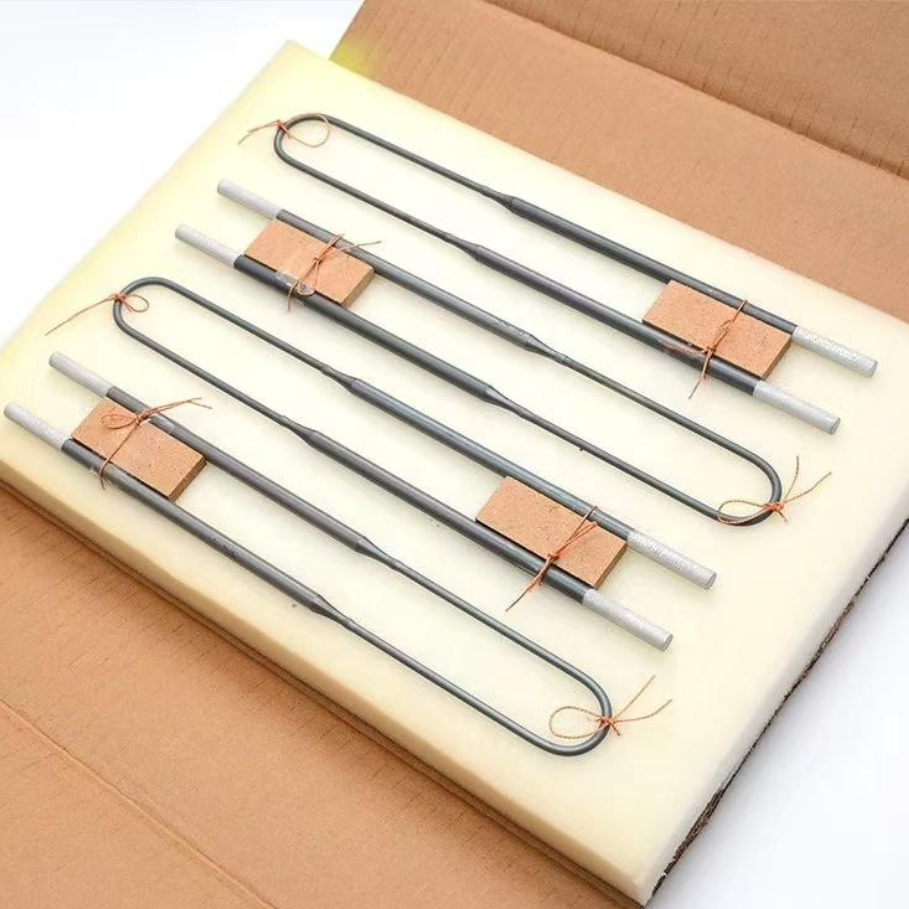
keyword: MoSi2 heating elements,Liaoyang Jiaxin,alloy furnace,quality verification,bulk order
description :Learn how to verify MoSi2 heating element quality before bulk orders to reduce furnace downtime, resistance issues, and sourcing risks.
Knowing how to verify quality of MoSi2 heating elements before bulk order is essential for avoiding premature failure, unstable resistance and costly furnace downtime. From material purity and density to dimensional accuracy, hot-zone performance and batch consistency, every detail affects service life. This guide explains the key inspection points and supplier evaluation standards buyers should check before placing a large order.
Why does MoSi2 heating element quality matter so much in alloy and high-temperature furnace applications?
In the alloy industry, furnace stability is not a minor issue. Small deviations in heating element quality can lead to temperature fluctuation, uneven heat distribution, oxidation damage, broken legs, or short service intervals.
MoSi2 heating elements are often selected for demanding kilns and industrial furnaces because they can work at very high temperatures and form a protective silica layer during operation. Even so, not every element sold on the market performs the same.
If you are trying to understand how to verify quality of MoSi2 heating elements before bulk order, you should evaluate more than the unit price. Material composition, manufacturing control, electrical resistance stability, machining precision, and packaging for export all affect the real procurement cost.
- Low-density or impure material may increase brittleness and shorten operating life under repeated thermal cycling.
- Poor resistance consistency within one batch can create uneven current loading and local overheating.
- Loose dimensional tolerance may cause difficult installation, clamp mismatch, or hot-zone positioning errors inside the furnace.
- Insufficient inspection before shipment can lead to hidden cracks that only appear after startup.
That is why experienced buyers compare quality verification methods before confirming large-volume contracts. A reliable supplier should be able to explain the whole process from raw material inspection to finished resistance testing and after-sales technical guidance.
How to verify quality of MoSi2 heating elements before bulk order: the first inspection checklist
Before discussing lab data or supplier capability, buyers need a practical front-end checklist. This helps you filter out weak offers early and focus only on factories that can support stable industrial use.
- Start with these visible and measurable points
- Check the surface condition. The element should have a uniform appearance without obvious pores, chips, warped sections, or visible transverse cracks.
- Confirm dimensions against your drawing. Pay attention to hot zone length, cold end diameter, center distance, overall length, and terminal geometry.
- Ask for resistance test values for each production batch. Resistance spread that is too wide can cause installation imbalance in multi-element systems.
- Review packaging details. Brittle high-temperature elements must be packed with shock protection and export-safe wooden cases for long-distance transport.
- Verify whether the supplier can provide sample trials before mass production. Sample validation is one of the most effective ways to reduce procurement risk.
For buyers searching how to verify quality of MoSi2 heating elements before bulk order, this initial checklist prevents many avoidable failures. It also reveals whether the supplier understands industrial furnace reality or only offers trading-level quotations.
Which technical parameters should buyers request before placing a bulk order?
A serious procurement decision needs clear technical documentation. Buyers should request measurable data, not broad claims. The table below shows the most useful parameters when evaluating MoSi2 heater quality before volume purchasing.
| Evaluation Item | What to Check | Why It Matters |
| Material purity | Consistency of raw material source and impurity control | Impurities may affect oxidation resistance, density, and high-temperature stability |
| Bulk density | Density uniformity within the same production lot | Lower or uneven density can increase fragility and shorten service life |
| Resistance value | Measured resistance and allowed tolerance per element | Stable resistance helps maintain balanced heating and predictable power loading |
| Dimensional tolerance | Diameter, hot zone, cold end, center spacing, total length | Precise dimensions reduce installation issues and furnace retrofitting errors |
| Operating temperature match | Recommended furnace temperature and atmosphere suitability | Not all designs suit the same thermal cycle, atmosphere, or installation structure |
When buyers ask how to verify quality of MoSi2 heating elements before bulk order, this parameter set gives a more objective basis for comparison. It also helps engineering, purchasing, and maintenance teams use the same evaluation language.
Do not ignore hot-zone and cold-end matching
Many purchasing problems come from assuming that only overall length matters. In fact, the ratio between hot zone and cold ends influences thermal efficiency, terminal temperature, and clamp compatibility. A supplier should confirm these details against your furnace layout.
Liaoyang Jiaxin Carbide Co., Ltd. supports OEM and ODM production based on drawings, electrical parameters, and specific furnace conditions. This is especially valuable when standard dimensions do not fit an existing alloy furnace or a newly designed thermal system.
How to compare suppliers when you verify MoSi2 heating element quality?
Knowing how to verify quality of MoSi2 heating elements before bulk order also means knowing how to verify the supplier. Product quality and supplier capability are inseparable in industrial heating projects.
The comparison table below can help buyers review not only the element itself, but also the production and service system behind it.
| Supplier Review Point | Reliable Signal | Procurement Risk if Missing |
| Manufacturing experience | Long-term focus on high-temperature heating elements and refractory accessories | Inconsistent production control and weak application understanding |
| Inspection capability | Raw material checks, sintering control, finished resistance and dimension testing | Hidden defects may pass into shipment and appear only after installation |
| Engineering support | Power calculation, heating layout advice, operation guidance | Wrong element selection can cause overloading or poor furnace uniformity |
| Sample and MOQ flexibility | Support for trial order and practical MOQ negotiation | Buyers must take full risk before validating fit and performance |
| Export service | Fumigated wooden packing, flexible trade terms, responsive communication | Transport damage, document delays, and communication gaps during urgent procurement |
A quote may look attractive at first, but missing technical support often becomes expensive later. For industrial buyers, the best supplier is usually the one that reduces total operating risk rather than the one with the lowest initial price.
What supplier strengths matter most for alloy-sector buyers?
- Experience with high-temperature applications such as non-ferrous metallurgy, powder metallurgy, glass processing, and laboratory furnaces.
- Ability to customize element shape, terminal size, and matched accessories for different furnace structures.
- Understanding of international shipping, breakage prevention, and after-sales troubleshooting for overseas installations.
Liaoyang Jiaxin Carbide Co., Ltd., founded in 2007, combines manufacturing, export service, inspection, and technical support. For buyers placing repeat or cross-border orders, this integrated model helps reduce coordination errors between sourcing, engineering, and delivery teams.
What problems usually appear when buyers skip quality verification before bulk ordering?
Many furnace failures are not caused by the control system alone. They begin with procurement shortcuts. If you do not carefully verify MoSi2 heater quality, the hidden cost may exceed the product price difference by several times.
- Common procurement mistakes
- Ordering only by a previous sketch without confirming whether the furnace structure, voltage, and power design have changed.
- Comparing quotations without checking whether resistance tolerance and dimension tolerance are included in the supplier’s inspection scope.
- Ignoring batch consistency and accepting one approved sample as proof that mass production will be identical.
- Not asking about startup guidance, replacement intervals, or compatible clamps and conductive accessories.
This is exactly why the question how to verify quality of MoSi2 heating elements before bulk order should be addressed by both procurement and technical teams. A heater is not an isolated spare part. It is part of a high-temperature system.
Which testing and approval process is practical before mass purchasing?
A structured approval process makes the buying decision safer, especially when the elements will be used in continuous or semi-continuous alloy production furnaces. The goal is to confirm fit, electrical balance, and service expectations before committing to bulk quantities.
Recommended pre-bulk order workflow
- Submit your furnace drawing, operating temperature, voltage, power requirement, atmosphere, and working cycle to the supplier.
- Request technical confirmation for element type, dimension, hot-zone design, and estimated resistance range.
- Order a sample or trial batch and inspect appearance, dimensions, packaging, and test data on arrival.
- Run a controlled installation test and monitor startup current, temperature rise, and heat distribution inside the furnace.
- Approve the batch standard, then confirm production lead time, final quantity, spare ratio, and export terms.
For global buyers, this process also clarifies logistics timing. Liaoyang Jiaxin Carbide Co., Ltd. supports sample trials, reasonable MOQ, and technical communication within 24 hours, which is useful when project schedules are tight and shutdown windows are short.
How do application scenarios affect your quality judgment?
The answer to how to verify quality of MoSi2 heating elements before bulk order changes slightly by application. Different furnace uses place different stress on the element, so the acceptance focus should also shift.
The table below shows how application scenario influences evaluation priorities.
| Application Scenario | Priority Quality Focus | Procurement Suggestion |
| Non-ferrous metallurgy furnace | Thermal shock resistance, structural stability, resistance balance | Confirm working cycle and furnace atmosphere before finalizing shape and rating |
| Ceramic or zirconia sintering kiln | Temperature uniformity, hot-zone consistency, dimensional precision | Request tight tolerance and check layout compatibility with kiln chamber geometry |
| Laboratory high-temperature furnace | Fast response, small-batch consistency, installation convenience | Use sample verification and ensure replacement parts can be reordered quickly |
| Glass processing furnace | Oxidation stability, thermal field balance, long-run endurance | Discuss duty cycle and maintenance interval before bulk order approval |
priorities.
This scenario-based review prevents generic buying decisions. It also helps you request the right inspection points from the supplier instead of using the same checklist for every furnace type.
FAQ: what else should buyers know before confirming a large MoSi2 heater order?
Should I approve a bulk order based only on one sample?
No. A sample is useful, but it does not fully prove batch consistency. Ask how the supplier controls raw material batches, sintering conditions, resistance sorting, and dimensional inspection for the full production lot.
Is lower resistance always better for furnace performance?
Not necessarily. The key is matching resistance to your voltage, transformer configuration, and furnace power design. Incorrect resistance can overload the circuit or reduce heating efficiency. Always verify the full electrical scheme.
How important is packaging when buying MoSi2 heating elements overseas?
It is very important. MoSi2 elements are brittle compared with ordinary metal parts. Poor export packaging can cause micro-damage during handling or sea transport. Standard fumigated wooden export packing with internal shock protection is a practical requirement.
What documents should I ask from the supplier?
Ask for quotation with detailed dimensions, resistance values or range, quantity breakdown, packaging description, lead time, and trade terms. For custom orders, request drawing confirmation and written technical agreement before production begins.
Why choose us for MoSi2 heating element verification and bulk supply support?
If you are working through how to verify quality of MoSi2 heating elements before bulk order, you need more than a catalog supplier. You need a manufacturing partner that can connect drawings, furnace conditions, inspection data, delivery planning, and after-sales support.
Liaoyang Jiaxin Carbide Co., Ltd. focuses on high-temperature industrial heating elements, silicon carbide refractory parts, precision graphite components, and matched furnace accessories. Our business covers R&D, customized production, inspection, global sales, and technical after-sales service for industrial users in Asia, Europe, North America, Latin America, the Middle East, and Africa.
- We support OEM and ODM production based on customer drawings, technical parameters, and special furnace working conditions.
- Our engineering team can assist with heating power calculation, heating layout design, and operation guidance before order confirmation.
- We apply full-process quality control from raw material inspection and high-temperature sintering to finished resistance and dimension testing.
- We offer sample trial orders, practical MOQ arrangements, controllable lead time, export wooden packaging, and FOB, CIF, DAP, and other trade terms.
If you need support with parameter confirmation, product selection, delivery schedule, sample evaluation, replacement planning, or quotation comparison, contact us with your furnace drawing and operating conditions. We can help you review dimensions, resistance matching, accessory compatibility, and bulk order feasibility before production starts.
Điều mình hài lòng là 188v ios hoạt động tốt trên cả iPhone lẫn Android. TONY07-20
please add me by whatsapp :+8615804230746
email : jiaxincarbide@outlook.com
Sau vài hôm dùng thử slot365 app , mình cảm thấy trải nghiệm tổng thể khá tốt. TONY07-20
please add me by whatsapp :+8615804230746
email : jiaxincarbide@outlook.com